English project - Introduction and description of the blog.
Obtener vínculo
Facebook
X
Pinterest
Correo electrónico
Otras apps
IDEAL CITY CLASSROOM PROJECT.
MEMBERS:
Maick Steven Neira Santos 10°C
Javier Camilo Martinez Pineda 10°C
Nicholas Diaz Child 10°C
Nicolas Barrios Galvis 10°C
Jhonatan Steven Celis Sanabria 10°C
INTRODUCTION:
This project is made up of the subjects of Assertive Communicators (Debate-Blog-Localities), Socials (identification of the Subnormal Neighborhoods problem) and Communicators of Another Language (Introduction of the project).
The problem that we presented was the subnormal neighborhoods and the locality that we chose was Rafael Uribe Uribe
PART OF SOCIALS:
PROBLEM: Subnormal neighborhoods.
What are subnormal neighborhoods?
It is the human settlement located in the headwaters of municipalities or districts that meets the following requirements:
that does not have residential public electricity service or that it is obtained through derivations of the Local Distribution System or a Connection, carried out without the approval of the respective Network Operator
that they are not areas where the home public service of electricity in general must be suspended in those areas in which it is prohibited to provide the service.
How many informal settlements are there in Colombia?
There are more than 55,450 precariously built homes in the Colombian capital, according to the first Report on Informal Settlements in Bogotá carried out by Techo, which insists on the conditions of poverty linked to this type of suburb.
The settlements, whose population is equivalent to 2.7% of the total of Bogotá, have a high presence of people displaced by an internal conflict that the country has been experiencing for more than 50 years, which according to official figures has expelled more than six million of people from their homes.
"65% of the informal settlements in Bogotá have a displaced population," said Daniela Carvajalino, social director of Techo Colombia, quoted in the statement.
Explanatory video on the services of subnormal neighborhoods:
The largest cases of subnormal neighborhoods are found on the Caribbean coast, mainly due to the negligence of the electricity company (ElectriCaribe).
1 Case
One of the largest cases of a subnormal neighborhood is found in Santa Marta, exactly in the Ciénaga neighborhood, where, apart from pollution, one of its biggest problems is the lack of drinking water, since nothing has been done since the 1990s. to solve it and this leads us to the next issue or affectation of the Ciénaga neighborhood which is the absence of comprehensive management since despite all the institutional and scientific effort that was made in the 90s for the recovery of the Ciénaga, today the management of the entities that must ensure the preservation of this lagoon complex, such as the Regional Autonomous Corporation of Magdalena (Corpamag) and the Ministry of the Environment, has fallen short. Below is a graph which shows us the drought suffered in this particular part.
Problems of Subnormal Neighborhoods
In the case of Subnormal Neighborhoods, the figures show unflattering results. Of around 20,000 neighborhoods designated as such in 2005, in 2007, 25,000 were registered, that is, an increase of 25%. In addition, the presentation and approval of projects to normalize these areas is extremely low.
The main conclusions drawn from the analysis of Subnormal Neighborhoods are listed below:
1. It was found that the income of the electricity service trading companies is reduced as the neighborhoods are normalized, which constitutes a disincentive to the presentation of normalization projects, a task that according to the current regulation precisely remained in hands of these companies.
2. It is concluded that the recent change in regulations in turn generates a change in the benefits obtained by the companies that market the electricity service, which presumably will imply a different behavior on their part in the face of network normalization projects. electrical. CREG Resolution 097 of 2008, by reducing the rate that companies charge, caused an alignment of incentives towards the correct side, since now there is a higher expected benefit for companies in the event of reaching normalization.
3. It was shown that the estimates made for an average Subnormal Neighborhood indicate that although the new noma points to the right side, the expected benefit of the company if it decides to carry out the normalization project is not as attractive as that presented by the alternative proposal with prepaid meters. According to the estimates presented, the proposal for the installation of prepaid meters would immediately raise the collection to 100% for the companies, resulting in a much more interesting contract than the current one.
In a final conclusion, we consider it highly debatable to maintain a subsidy that stimulates the consumption of electrical energy at all costs in the face of a global environment of enormous concern about climate change and greater awareness of the rational use of natural resources. The Mexican and Argentine experience is relevant in this regard, since their subsidy scheme establishes a higher charge while consumption is higher. This feature, in addition to promoting the rational use of energy among users, directs resources to the poorest population.
Lastly, although the available information does not reveal that the consumption of users of Subnormal Neighborhoods is greater than that of users of similar socioeconomic conditions and who are not covered by the subsidy, it is worth mentioning that this may well be due to overestimates of the size of these areas, since the disbursements of resources are tied to the number of users and there is no oversight over the registration of inhabitants.
PART OF SPANISH:
How the town of Rafael Uribe started:
The locality 18 Rafael Uribe Uribe, historically was part of the old municipality of Usme and goes back to its historical memories. Large farms made up its territory, which were giving way to the urban expansion of the city.
His doubling from the Colony was presented with the distribution of land among the most influential people in Bogotá. Thus, farms and haciendas stand out such as “Llano de Mesa, Santa Lucía, El Porvenir, La Yerbabuena, San Jorge, El Quiroga, Granjas de San Pablo, Granjas de Santa Sofía, Los Molinos de Chiguaza and La Fiscala.
“It has a flat part, an extension of the Sabana de Bogotá, where the oldest homes in the town are concentrated and another
part of the mid-mountain, broken territory and slope of accelerated and disorderly growth, of urban misuse and exploitation of quarries and quarries”.
With the accelerated expansion of Bogotá in the 20th century and the armed conflict in the country, “the real expansion began in the 1940s and 1950s, when the great migrations of the population fleeing the violence from the countryside to the city took place. This led immigrants to build their homes in the upper parts, to the east of the sector, which makes it difficult to provide basic services.
Why is that town called that?:
The town is an irregular territory in an area of 1,310 hectares. Its name pays homage to the liberal general of the Thousand Days War, Rafael Uribe Uribe and former president of the Republic of Colombia.
Places to visit in the town of Rafael Uribe Uribe:
LA PIEDRA DEL AMOR:
This imposing stone is recognized because it is precisely located in the area where the 'Entre Nubes' park is born, a park that also runs through the town of San Cristóbal and Usme. It is an emblematic and costumbrista stone where couples in love met, and left their signature as a symbol of love, a tradition that is still preserved. Also the memory of casual photos. It was the scene of "political" meetings of the time that left an urban legacy of social service.
LAS LAVANDERAS
The natural way these streams emanate from the mountain, almost become a kind way of nature to obtain and take advantage of this source of water, known as LAS LAVANDERAS through decades became a meeting place between inhabitants to wash the clothes daily and was also used as a place for gatherings to discuss what to do and events that aroused among the community. This place is listed as cultural heritage.
EL MIRADOR PARROQUÍA LA RESURRECCIÓN
This is another of the fascinating viewpoints that the country's capital has, located in the La Resurrection neighborhood, exactly in the parish that bears the same name. It is an open-air space, with a height, where we can observe 60% of the Bogotá Metropolis and from this point we saw the birth and growth of stories of the capital such as the San Carlos hospital, Reyes Magos and Holy Week festivities in I live with Monsignor Alfonso Garavito.
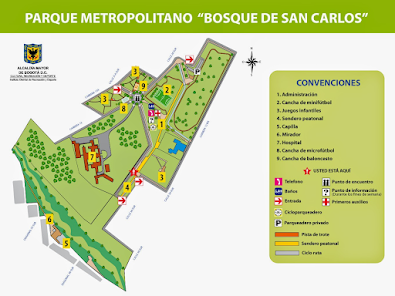
PARQUE METROPOLITANO BOSQUES SAN CARLOS:
The Parque Metropolitano Bosques San Carlos is cataloged as the lung of the south of Bogotá, next to the 'Entre Nubes' park, this park is a sports venue that can hold up to 2,500 fans of Bogota soccer.
Their customs:
The town has been working for several years on Artistic, Cultural and Patrimonial issues.
This began when the Council for Art, Culture and Heritage began a daily struggle of the different cultural associations, artists from different regions of the country were articulated, managing to contribute knowledge, experiences and experiences for the creation of the General Law of Culture, which , starting with the 1991 Constitution, have taken them into account.
At the beginning of the new millennium, the Arts, Culture and Heritage Council reached its peak, a golden age where they savored the sweetness of success.
More than anything, art and culture worked to be something different where you can visit and see a good culture.
Tradition:
street football:
If you want to know the points where "micro" or "banquitas" are played in the city, typical in Bogotá, you should be clear that the town of Rafael Uribe is one of the favorites to be part of this.
The Olaya Herrera Stadium Park is the main protagonist,
where hundreds of people usually gather on Sundays with the intention of strengthening their knowledge of street soccer, or simply wanting to enjoy a good morning accompanied by a game with friends.
With his tennis shoes well on and his knee-high socks, we meet Jhonatan Valencia, an athlete who has been practicing different tricks for five years, such as bouncing a ball on the balls of his feet more than 40 or 50 times.
Bridges neighborhood:
This neighborhood, made up of almost four hundred houses, surrounded by hills and with an essentially agricultural past, this town, where some 351,000 inhabitants live, has all kinds of neighborhoods, some historically marginal and also marginalized by the authorities.
To improve the situation of the almost one thousand residents and the neighborhood itself, in 2017 a macro-project began to train the inhabitants of Los Puentes so that, supported by experts, they could turn their neighborhood into a great mural, not only in terms of facades refers, but also to stairs and any other element of common use.
This served to strengthen ties, helped to increase the value of homes and to the town of Los Puentes many tourists arrived. All this has had a positive impact on the economy of the neighborhood, in which several stores focused on this new reality have even opened.
Problems of the Rafael Uribe Uribe locality:
In the Fundación Miradas Colectivas Bogotá D. C, they worked with 5 families from this community, the main problem was noise pollution due to the high volumes of music that are handled by leisure establishments and by the families themselves. This has brought serious consequences, of a physical, psychological and social nature, which decisively affects their quality of life. The noise pollution that occurs in several neighborhoods and generates an environment of hostility in the community, conflicts between neighbors are evident and different and several cases are reported showing uneasiness.




Comentarios
Publicar un comentario